Industrial plants rarely lose energy in one dramatic event. Losses accumulate through pumps, fans, compressors, conveyors, and oversized motors running at fixed speed. An AC Drive Motor, paired with a variable frequency drive, adjusts speed and torque to match the actual load. This can reduce throttling, mechanical stress, and unnecessary electricity consumption.
The International Energy Agency reports that electric motor systems consume approximately 53% of global electricity. The U.S. Department of Energy also estimates that motor-driven equipment represents about 70% of industrial electricity use in the United States. These figures explain why drive selection deserves engineering attention. They do not guarantee savings in every installation. Poor programming, harmonics, inadequate cooling, or frequent overloads can reduce performance.
Paul Waide, an energy-efficiency specialist and former IEA analyst, stated, “Electric motor systems are the single largest end use of electricity worldwide.” His observation remains highly relevant on a factory floor, where a pump may run continuously despite changing demand. An AC Drive Motor can respond more precisely, while providing soft starting, speed control, and useful diagnostic data. The practical result depends on correct sizing, commissioning, maintenance, and measured operating conditions. Assumptions should be tested.
A reliable evaluation should compare power consumption, duty cycles, process requirements, and total ownership cost. The best choice is not always the newest motor. It is the system that delivers stable production with fewer avoidable losses.
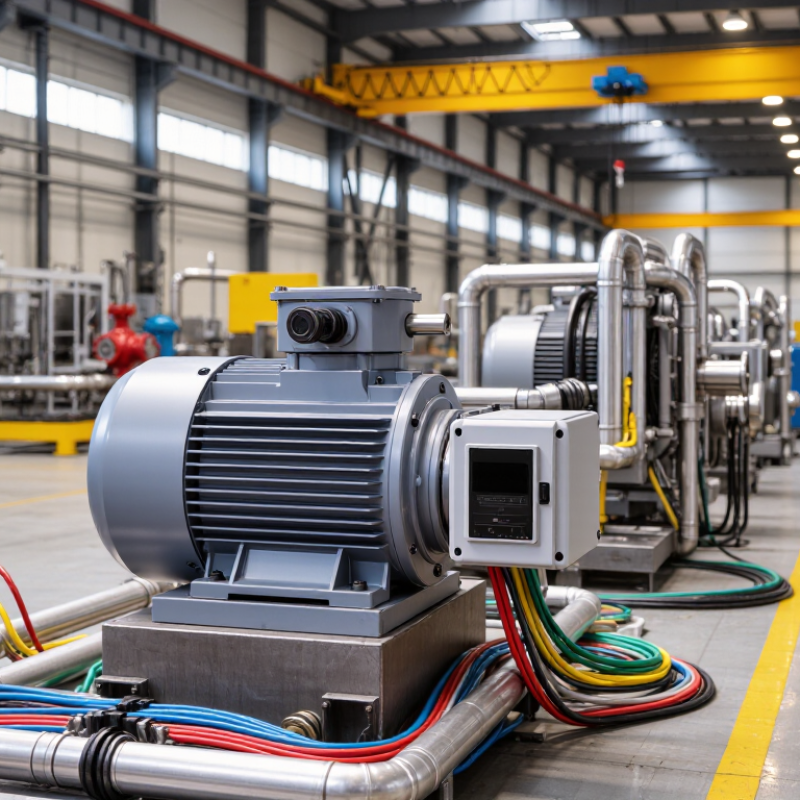
An AC drive motor is an alternating-current motor controlled by an adjustable-speed drive. It is not simply a motor with a clever switch. The drive converts incoming AC power through a rectifier, DC link, and inverter. The inverter then produces controlled voltage and frequency for the motor.
This arrangement changes speed, torque, and acceleration to match the process. A conveyor can start smoothly instead of jolting a loaded gearbox. A pump can reduce speed during low demand, rather than wasting energy through throttling.
The International Energy Agency reports that electric motor systems consume roughly 50% of global electricity. Even modest speed reductions can therefore influence operating costs significantly. The U.S. Department of Energy also identifies motor-driven equipment as a major industrial energy-use category.
In commissioning work, technicians commonly check current balance, ramp times, grounding, and motor temperature. These details matter. A poorly selected drive may create harmonics, audible noise, or bearing-current damage. Long cable runs can also increase insulation stress. The correct solution depends on load profile, duty cycle, enclosure rating, and required braking performance. Oversizing the motor is not automatically safer; it may reduce efficiency and weaken control at low speed.
The phrase “AC drive motor” is useful, but technically incomplete. The motor and drive operate as one engineered system, and that distinction is easy to overlook.
An AC drive motor gives industrial equipment precise control over speed and torque. The drive changes the motor’s input frequency and voltage. Lower frequency slows the shaft for careful conveyor movement. Higher frequency increases speed when production demand rises. This control reduces mechanical shock during starting and stopping.
Torque control matters when loads change suddenly. A filled conveyor may resist movement more than an empty one. The drive senses current demand and adjusts output to maintain turning force. Feedback devices can improve accuracy in elevators, mixers, and winding machines. Acceleration ramps also protect couplings, belts, and gearboxes from sudden strain.
Small settings matter. Poor tuning can cause vibration, overheating, or weak low-speed torque. Operators should match motor data with drive parameters and inspect the load profile. In field maintenance, unusual noise often signals incorrect settings before serious damage appears. Cooling needs attention too, because a motor running slowly may receive less fan airflow. AC drive systems are efficient, but their results depend on installation quality, realistic torque requirements, and regular checks.
AC drive motors regulate speed by adjusting the supply frequency and maintain approximately constant rated torque below base speed. Above base speed, torque gradually decreases as the motor enters the field-weakening region.
Illustrative engineering profile based on a 50 Hz base-speed motor. Speed is shown as a percentage of rated speed, while torque is shown as a percentage of rated torque.
Why Choose an AC Drive Motor for Industrial Applications?
AC drive motors offer practical benefits across manufacturing, pumping, ventilation, and material-handling operations. Their speed can be adjusted to match changing production demands. This control reduces unnecessary energy use during partial-load conditions. It also helps equipment start smoothly, limiting mechanical shock in shafts, belts, and gearboxes.
In daily plant operation, operators often notice quieter starts and steadier process control. An adjustable frequency drive can regulate motor speed without relying only on valves, dampers, or mechanical throttling. That may reduce wear and improve product consistency. AC motors are also widely available, familiar to maintenance teams, and suitable for demanding environments when correctly specified. However, performance is not automatic. Poor sizing, heat buildup, or incorrect parameter settings can create faults. I have seen energy-saving expectations fall short when the driven load was never assessed properly.
Tips: Check the load profile before selecting the motor and drive. Confirm voltage, torque, enclosure protection, cooling, and ambient temperature requirements. Keep cables properly installed and inspect connections during scheduled maintenance. Record operating current, vibration, and temperature trends. Small changes can reveal developing problems early. Do not assume lower speed always means lower cost; some pumps and fans respond well, while constant-torque machinery may require careful control. Local electrical standards and qualified technicians should guide installation and testing.
AC drive motors suit industrial applications where speed, torque, and energy use must change during operation. Their adjustable frequency control supports smooth acceleration, controlled stopping, and steady production. This makes them practical for conveyor systems moving cartons, bottles, or heavy pallets. Operators can reduce sudden jerks and protect gearboxes, belts, and transported goods.
Pumps and fans are another strong match. In water treatment plants, a drive motor can adjust pump speed as demand changes. Cooling towers and ventilation systems can reduce airflow during quieter periods. This often lowers energy consumption compared with constant-speed operation. Compressors, mixers, and extruders also benefit when processes require careful speed control. Small changes matter.
Machine tools and automated production lines need repeatable movement. An AC drive motor can provide controlled ramping and useful torque at low speeds. During commissioning, technicians should check motor loading, cooling, cable length, and harmonic effects. A poorly selected drive may overheat or create unstable operation. That part is easy to underestimate. Dust, moisture, washdown routines, and frequent starts also influence the enclosure and motor duty rating.
Not every application needs an AC drive motor. Simple constant-speed equipment may operate more economically with a basic motor and starter. The better choice depends on the process, not fashion. Real operating data should guide the decision, although measurements are sometimes incomplete. A short trial under normal production conditions can reveal problems that a specification sheet misses.
| Industrial Application | Typical Load Profile | Why an AC Drive Motor Is Suitable | Key Control Requirement | Energy and Process Benefit | Important Design Considerations | Suitability |
|---|---|---|---|---|---|---|
| Conveyors | Constant-torque load with frequent starting, stopping, or speed changes. | Provides controlled acceleration and deceleration, reducing mechanical shock to belts, gearboxes, and conveyed products. | Low-speed torque, ramp control, speed synchronization, and controlled stopping. | Improves material-flow control and can reduce idle running when production demand changes. | Check starting torque, belt tension, braking requirements, and motor cooling at low speed. | Excellent |
| Centrifugal Pumps | Variable-torque load; required torque decreases as speed decreases. | Allows pump speed to follow process demand instead of relying only on throttling valves. | Stable pressure or flow control, minimum-speed protection, and smooth ramping. | For similar pump conditions, affinity laws indicate that flow varies approximately with speed, pressure with speed squared, and power with speed cubed. | Confirm minimum flow, cavitation limits, fluid temperature, and motor insulation suitability. | Excellent |
| Fans and Blowers | Variable-torque load with demand that changes during operation. | Provides efficient airflow adjustment by changing motor speed rather than continuously restricting air with dampers. | Constant airflow or pressure control, acceleration limits, and minimum operating speed. | Fan affinity laws show that power requirement is approximately proportional to the cube of rotational speed, making speed reduction highly effective for part-load operation. | Account for system pressure, filter loading, resonance, noise, and motor cooling. | Excellent |
| Compressors | Variable or constant-torque load depending on compressor design and operating point. | Supports controlled capacity adjustment, reduced mechanical stress, and smoother starting of high-inertia equipment. | Pressure control, minimum and maximum speed limits, overload protection, and anti-short-cycle logic. | Can reduce unloaded running and maintain process pressure more closely when demand varies. | Verify compressor manufacturer limits, lubrication requirements, discharge temperature, and torsional behavior. | Very Good |
| Mixers and Agitators | Constant-torque load; torque may increase with product viscosity or batch density. | Enables gradual acceleration and precise speed adjustment for different materials and recipes. | High starting torque, stable low-speed operation, current limiting, and programmable speed profiles. | Improves batch consistency and can reduce splashing, foaming, and excess mechanical stress. | Size for worst-case viscosity, consider hygienic or hazardous-area requirements, and verify shaft dynamics. | Excellent |
| Machine Tools | Speed and torque requirements vary with cutting operation, tool diameter, and material. | Offers adjustable spindle speed and controlled acceleration for different machining conditions. | Fast speed response, accurate frequency control, braking, and stable operation across the required speed range. | Supports process flexibility, surface-finish control, and reduced setup time between operations. | Evaluate encoder feedback, bearing currents, braking energy, vibration, and spindle cooling. | Very Good |
| Cranes and Hoists | High starting torque with frequent acceleration, deceleration, and load changes. | Provides smooth lifting and lowering control while limiting shock loads in the drivetrain and structure. | Torque control, safe stopping, brake coordination, overload protection, and controlled regeneration or braking. | Improves positioning accuracy and reduces load swing compared with abrupt on-off motor operation. | Use a properly rated duty cycle, mechanical holding brake, emergency-stop design, and load monitoring. | Very Good |
| Extruders | Constant-torque process load with high torque demand at low speed. | Maintains controlled screw speed and supports stable material throughput during production changes. | High continuous torque, precise speed regulation, overload capability, and thermal monitoring. | Improves product consistency and reduces waste during startup and process transitions. | Consider low-speed motor cooling, gearbox ratio, melt pressure, duty rating, and torque margin. | Excellent |
| HVAC Chilled-Water Systems | Variable-flow pump and fan loads that change with building or process demand. | Matches motor speed to actual heating, cooling, and ventilation requirements. | Pressure, temperature, or airflow feedback with automatic setpoint control. | Reduces unnecessary full-speed operation and supports efficient part-load performance. | Coordinate bypasses, minimum-flow protection, harmonics, acoustic limits, and system controls. | Excellent |
Technical note: AC drive motors are commonly paired with variable-frequency drives to control motor speed and torque. Actual performance depends on motor design, drive settings, load characteristics, duty cycle, installation conditions, and applicable electrical and safety standards.
Selecting an AC drive motor begins with the machine’s real operating demands. Match the motor’s rated power, torque, speed range, and duty cycle to the application. Check starting torque carefully. Conveyors, pumps, and crushers behave differently. A motor sized only by horsepower may overheat during frequent acceleration. More power is not always better.
Confirm that the motor suits the drive’s output voltage, frequency range, and control method. Consider the enclosure rating, ambient temperature, dust, moisture, and installation altitude. In my experience, measuring the load before purchase prevents expensive corrections later. I have also seen calculations fail because operators underestimated peak loads. That deserves a second check.
During installation, align the shaft accurately and use suitable cables, grounding, and ventilation space. Keep power cables separate from sensitive signal wiring. Follow the manufacturer’s torque values for terminals. After startup, record current, vibration, temperature, and acceleration performance. Maintenance should include cleaning cooling paths, checking connections, inspecting bearings, and reviewing fault history. Small changes often appear before a serious failure.
Tips: Keep a simple maintenance log. Compare readings over time, not just against limits. Listen for unusual bearing noise. Check for loose mounts after the first week. Stop and investigate repeated drive trips; resetting them blindly can hide a developing problem. One practical improvement is to photograph terminal connections before servicing. It reduces confusion, although it should never replace proper isolation procedures.
It is an AC motor controlled by an adjustable-speed drive. The drive uses a rectifier, DC link, and inverter. It regulates voltage and frequency. The motor and drive work as one system.
The drive changes the motor’s input frequency and voltage. Lower frequency slows the shaft. Higher frequency increases speed. Smooth ramps reduce shocks to belts, couplings, and gearboxes.
They match motor speed to actual process demand. A pump can slow during low demand. A conveyor can start without jolting a loaded gearbox. This may reduce energy waste and operating costs.
The drive monitors current demand and adjusts its output. This helps maintain turning force when loads change. A full conveyor needs more torque than an empty conveyor. Feedback devices can improve control accuracy.
Match rated power, torque, speed range, and duty cycle to the machine. Check starting torque carefully. Conveyors, pumps, and crushers behave differently. More power is not always better.
Align the shaft accurately. Use suitable cables, grounding, and ventilation space. Separate power cables from sensitive signal wiring. Follow the specified terminal torque. Small installation errors can become expensive problems.
Poor tuning may cause vibration, overheating, or weak low-speed torque. Incorrect settings can also create audible noise. Long cables may increase insulation stress. The label “AC drive motor” can hide these details.
Clean cooling paths and inspect bearings regularly. Check connections, vibration, temperature, and fault history. Listen for unusual bearing noise. Keep a simple maintenance log. Compare readings over time.
Stop and investigate the cause. Do not reset it blindly. Repeated trips may indicate overheating, overload, wiring faults, or poor settings. Measure the load again. A second check is worthwhile.
An AC Drive Motor is an electric motor paired with a variable frequency drive to provide precise control over speed, torque, and direction. By adjusting the frequency and voltage supplied to the motor, the system can match machine performance to changing production requirements. This control method supports smoother acceleration and deceleration, reduces mechanical stress, and helps maintain stable operation across different load conditions.
AC Drive Motors offer energy efficiency, reliable performance, improved process control, and lower operating costs in many industrial environments. They are well suited for pumps, fans, conveyors, compressors, mixers, and other equipment requiring adjustable motion. Selecting the right motor involves evaluating power ratings, load characteristics, operating speed, environmental conditions, and control requirements. Proper installation should include suitable wiring, protection, grounding, and parameter configuration, while regular inspections, cooling checks, cleaning, and vibration monitoring help extend service life and prevent unexpected downtime.

AxisPro Motor